GHK-Cu Mechanism of Action: Within the field of cellular longevity and tissue architecture assays, the human tripeptide glycyl-L-histidyl-L-lysine (GHK) stands out due to its high binding affinity for copper ($Cu^{2+}$). The resulting complex—GHK-Cu—functions as a powerful biochemical modulator within preclinical dermal models. Widely studied for its ability to reshape the extracellular matrix (ECM), this micro-molecule allows investigators to track gene expression shifts governing cellular repair, antioxidant defense, and structural remodeling. This article provides an analytical look at the foundational GHK-Cu mechanism of action inside laboratory in vitro models.
1. The Molecular Carrier Dynamics of GHK-Cu
Biochemically, GHK-Cu operates primarily as a specialized carrier peptide. Copper is a vital cofactor for several key intracellular enzymes, including superoxide dismutase (which neutralizes oxidative stress vectors) and lysyl oxidase (which handles the critical cross-linking of structural collagen and elastin strands). However, free ionic copper can be highly toxic to cell cultures, triggering erratic free-radical generation if left un-chelated.
The GHK peptide sequence resolves this problem by perfectly wrapping around the $Cu^{2+}$ ion. This configuration safely chaperones the copper molecule directly to specific cell-surface receptors. Once bound, it facilitates controlled, non-toxic intracellular copper transport, smoothly fueling vital metabolic pathways without causing cellular stress or disrupting baseline culture viability.
2. Upregulating Collagen and Dermal Matrix Synthesis
When introduced to isolated dermal fibroblast cultures, GHK-Cu initiates a profound restructuring response within the extracellular matrix. Researchers track its influence across several primary structural vectors:
- Collagen Synthesis Stimulation: In vitro tracking shows that GHK-Cu directly accelerates the transcription of both Type I and Type III procollagen mRNA strands. This drives a significant increase in raw collagen output from healthy fibroblasts.
- Glycosaminoglycan (GAG) Production: The complex upregulates the synthesis of critical matrix components, including hyaluronic acid and decorin. This optimizes the structural scaffolding and moisture-retention metrics within simulated skin layers.
- Matrix Metalloproteinase (MMP) Modulation: Rather than forcing continuous, unchecked tissue growth, GHK-Cu exhibits a balancing effect. It regulates both MMPs (enzymes that break down damaged scar tissue) and TIMPs (their natural inhibitors), promoting orderly, parallel tissue restoration.
Procuring Analytical-Grade Dermal Research Reagents
Accurate tracking of matrix metalloproteinase or collagen pathways requires high-purity lyophilized assets free of baseline contamination or structural degradation.
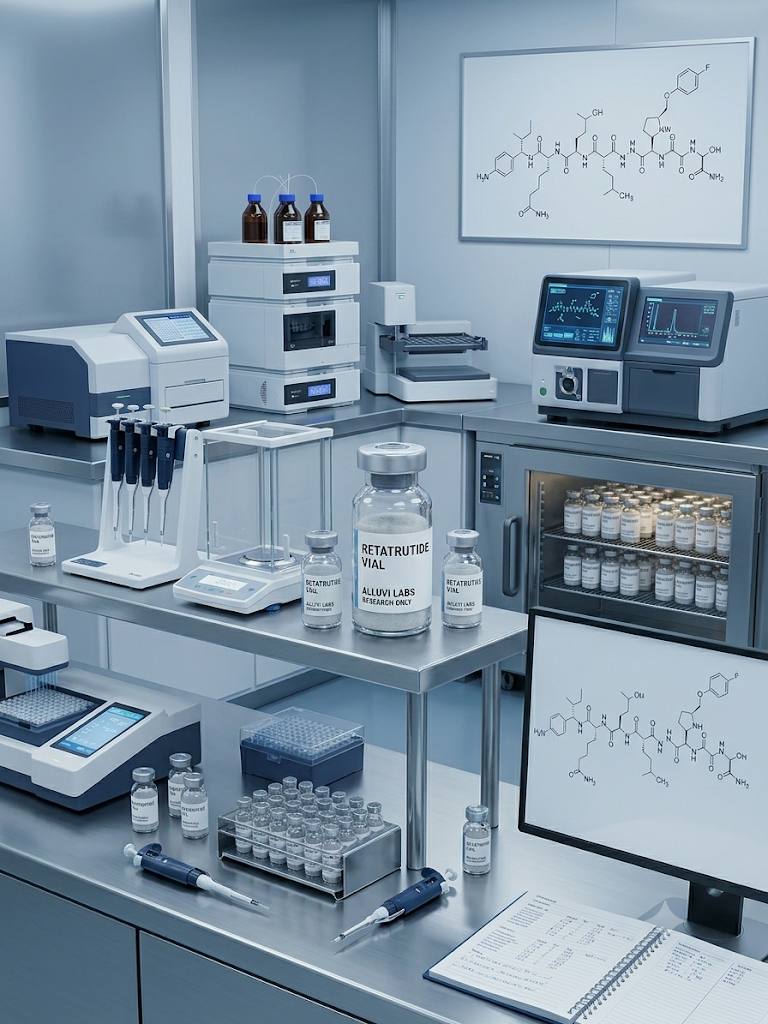
Buy HPLC-Verified GHK-Cu Reagents Figure 1: Intracellular tracking of synthetic co-agonist signaling vectors.
3. Genomic Signaling & Broad Cellular Longevity
Beyond immediate physical matrix changes, broad-scale genetic connectivity analysis shows that GHK-Cu alters the expression profiles of thousands of human genes. In preclinical longevity assays, researchers focus intensely on its ability to shift gene readouts back toward a healthier, more resilient baseline:
- Antioxidant System Induction: The compound upregulates genes handling endogenous cellular shielding, helping cultures clear metabolic waste and better survive environmental stressors.
- DNA Repair Pathway Activation: Investigators observe an increased presence of DNA repair markers, tracking the stabilization of replication sequences during prolonged cell dividing cycles.
4. Reconstitution and Reagent Stability Profiles
GHK-Cu presents as a distinctively vibrant blue lyophilized cake due to its copper content. To prevent premature dissociation of the copper-peptide complex, the compound must be protected from extreme UV light exposure and severe heat. Store un-reconstituted vials at -20°C. When ready for analysis, dissolve the lyophilized mass gently using Sterile Bacteriostatic Water. Slowly roll the vial between your palms until completely clear; never shake aggressively, as this can degrade the secondary peptide binding configurations.
⚠️ Preclinical Integrity Notice
All laboratory assets documented within this registry are distributed exclusively for verified laboratory research, analytical control trials, and foundational in vitro testing models. This chemical compound is strictly not approved for human therapeutic, clinical, veterinary, or diagnostic administration.