Alluvi bpc 157. In preclinical tissue regeneration and cellular recovery research, BPC-157 (Body Protection Compound-157) remains one of the most widely investigated pentadecapeptides. Originally derived from a protective protein segment isolated from human gastric juice, this synthetic 15-amino-acid sequence exhibits exceptional molecular stability in aqueous solutions. When sourcing Alluvi BPC 157 research reagents, laboratories require verified analytical purity, structural sequence integrity, and lot-specific quality controls to ensure consistent assay outcomes.
1. Primary Angiogenic & Nitric Oxide Pathways
BPC-157 exerts its biological activity through distinct, interconnected cell signaling mechanisms that modulate cellular repair dynamics:
- VEGFR2 & Akt-eNOS Signaling: BPC-157 upregulates Vascular Endothelial Growth Factor Receptor 2 (VEGFR2) expression, stimulating downstream Akt-eNOS activation to promote rapid endothelial migration and blood vessel formation (angiogenesis).
- FAK-Paxillin Pathway: In tendon and ligament fibroblast cultures, BPC-157 activates focal adhesion kinase (FAK) and paxillin, increasing cell survival and outgrowth across connective tissue models.
- Nitric Oxide System Homeostasis: The peptide interacts with nitric oxide (NO) synthesis pathways, acting in parallel with eNOS modulators to preserve vascular stability during physiological stress.
VEGFR2 Activation ➔ Akt-eNOS Phosphorylation ➔ Endothelial Tube Formation ➔ Enhanced Localized Perfusion
2. Preclinical Research Applications
High-purity BPC-157 pentadecapeptide reagents are integrated across several primary experimental setups:
- Tendinous & Musculoskeletal Assays: Evaluating fibroblast proliferation, type I collagen synthesis, and myotendinous junction healing.
- Gastrointestinal Mucosal Models: Assessing cytoprotection and epithelial barrier repair in animal models of mucosal injury.
- Vascular Endothelial Migration: Measuring capillary sprouting rates and cellular response under hypoxic conditions.
Order HPLC-Verified Alluvi BPC-157 Vials
Source high-purity, laboratory-tested BPC-157 pentadecapeptide reagents (>99% purity) complete with mass spectrometry verification.
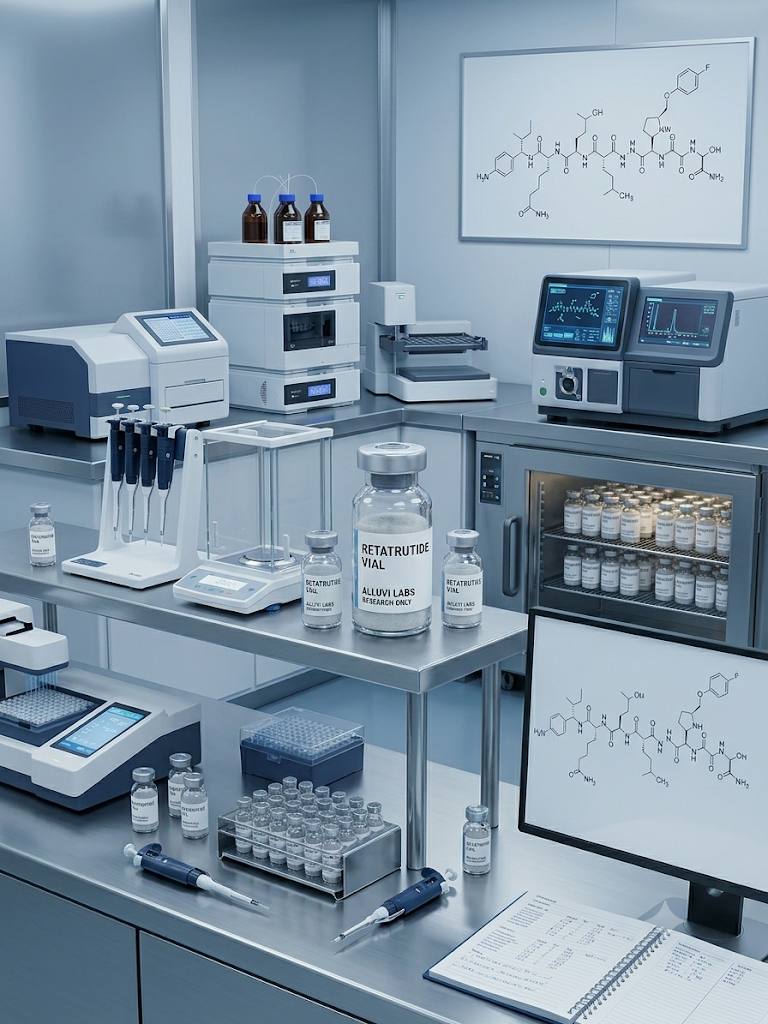
Buy BPC-157 Vials Figure 1: Analytical-Grade Alluvi BPC-157 Reagent Vials.
3. Handling, Reconstitution & Cold-Chain Storage
To maintain compound integrity and prevent enzymatic or thermal degradation:
- Store freeze-dried, lyophilized powder at -20°C in a desiccated environment upon delivery.
- Reconstitute using sterile bacteriostatic water or saline under aseptic laminar flow hood conditions.
- Divide reconstituted liquid into working aliquots to avoid structural damage caused by repeated freeze-thaw cycles.
⚠️ Preclinical Integrity Notice
All laboratory assets documented within this registry are distributed exclusively for verified laboratory research, analytical control trials, and foundational in vitro testing models. This chemical compound is strictly not approved for human therapeutic, clinical, veterinary, or diagnostic administration.