Cagrilintide Mechanism of Action: While single-vector weight regulation models have historically dominated metabolic research, the preclinical focus has shifted decisively toward multi-hormonal pathways. Mono-therapies often hit biochemical plateaus due to compensatory physiological counter-regulations. To bypass these limitations, modern investigators are looking closely at Cagrilintide—a next-generation, long-acting synthetic amylin analog. By mimicking native pancreatic signaling, Cagrilintide introduces an independent metabolic vector that functions entirely outside standard incretin pathways. This guide breaks down the foundational Cagrilintide mechanism of action within in vitro cellular frameworks.
1. Molecular Design and Lipidation Profiles
Endogenous amylin is a peptide hormone co-secreted with insulin by pancreatic beta cells. It plays a critical role in slowing gastric emptying and signaling fullness. However, native human amylin is highly unstable in a laboratory setting, prone to rapid clearance and structural aggregation (forming amyloid fibrils that complicate assay consistency).
Cagrilintide circumvents these physical vulnerabilities through precision structural modifications. It features a specialized fatty acid side-chain (lipidation segment) attached to its amino acid backbone. This deliberate modification allows the peptide to form reversible, stable bonds with albumin within culture mediums. The resulting structural stability protects the peptide from immediate proteolytic breakdown, extending its operational baseline and allowing for long-duration metabolic monitoring windows.
2. Non-Selective Amylin Receptor Agonism
The primary Cagrilintide mechanism of action relies on its potent, non-selective activation of all major Amylin Receptor subtypes ($AMY_1$, $AMY_2$, and $AMY_3$), as well as Calcitonin Receptors (CTR). When introduced to targeted cell lines, Cagrilintide triggers independent physiological signaling pathways:
- Hindbrain Satiety Overlays: Cagrilintide binds directly to receptors within the area postrema (AP) and the nucleus tractus solitarius (NTS) of the hindbrain. This activation drives central metabolic satiety tracking, signaling fullness entirely independent of intestinal GLP-1 path structures.
- Gastric Emptying Modulation: In tissue assays evaluating smooth muscle motility, amylin receptor activation delays standard gastric fluid transit, helping model slowed nutrient absorption rates.
- Glucagon Suppression Vector: Concurrently, the peptide works on pancreatic alpha-cell profiles to suppress excess glucagon secretion during high-glucose simulations, balancing overall homeostatic readouts.
Sourcing High-Purity Amylin Agonists for Laboratory Assays
Evaluating non-incretin satiety vectors requires analytical chemical reagents with perfect amino acid fidelity, entirely free of structural aggregation or synthesis anomalies.
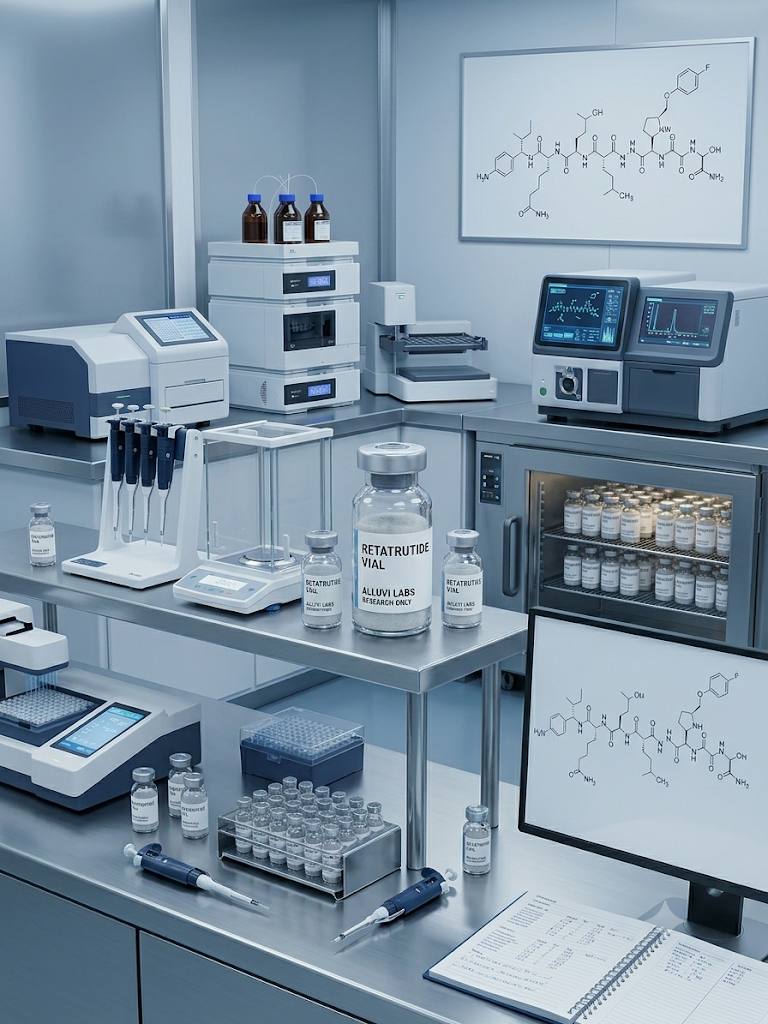
Buy HPLC-Verified Cagrilintide (5mg / 10mg) Figure 1: Cellular/Receptor Mapping Theme.
3. Preclinical Synergy with GLP-1 Receptor Agonists
The most common architecture in modern metabolic research involves pairing Cagrilintide directly with a GLP-1 receptor agonist (such as Semaglutide). Because these two families act on separate regions of the brain, their joint application creates a powerful dual-action synergy profile:
- Hypothalamus + Hindbrain Mapping: While GLP-1 compounds focus their signaling vectors on the arcuate nucleus of the hypothalamus, Cagrilintide acts primarily on the hindbrain, creating a comprehensive, multi-layered satiety readout across the entire central nervous system.
- Breaking Through Cellular Resistance: Combined baseline exposure models show a massive reduction in the standard receptor down-regulation trends that often appear when cells are exposed to massive doses of single-target agents over long periods.
4. Reconstitution and Reagent Preservation
To ensure reproducible data strings, Cagrilintide cakes must be handled under strict laboratory protocols. Keep un-reconstituted glass vials frozen long-term at -20°C in a dark environment. Prior to fluid integration, let the container sit until it reaches ambient room temperature. Reconstitute using Sterile Bacteriostatic Water, allowing the liquid to slide gently down the inside glass casing. Do not expose the solution to harsh mechanical vortexing or aggressive manual shaking, as this can easily disrupt the lipidation bonds and break down the secondary structure.
⚠️ Preclinical Integrity Notice
All laboratory assets documented within this registry are distributed exclusively for verified laboratory research, analytical control trials, and foundational in vitro testing models. This chemical compound is strictly not approved for human therapeutic, clinical, veterinary, or diagnostic administration.