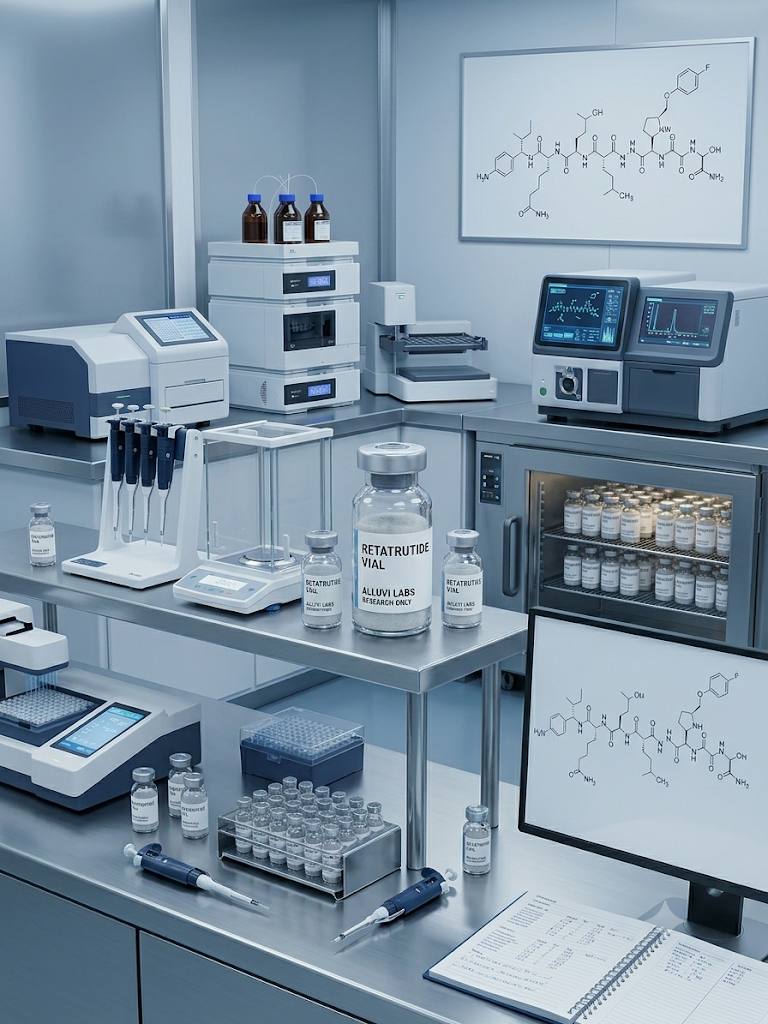
How to Reconstitute Peptides: In preclinical experimentation, transitioning a compound from storage to active deployment requires flawless execution. For investigators working with lyophilized solids, mastering how to reconstitute peptides is the single most critical step in preserving structural integrity. Imprecise fluid addition, improper mathematical ratios, or physical shock during fluid integration can instantly degrade delicate amino acid chains, rendering an entire batch useless. This technical guide outlines the exact laboratory protocols required to calculate, dilute, and store research peptides for highly reproducible assay results.
1. Calculating the Reconstitution Matrix
Before introducing any liquid vector to a lyophilized cake, you must determine your target concentration baseline. Reconstitution relies on a simple mass-to-volume ratio:
Target Concentration (mg/mL) = Total Peptide Mass (mg) ÷ Volume of Diluent (mL)
For example, if an investigator has a 10mg vial of Tirzepatide and introduces 2.0 mL of Sterile Bacteriostatic Water, the resulting concentration matrix yields exactly 5mg of active compound per milliliter of fluid ($10\text{ mg} \div 2.0\text{ mL} = 5\text{ mg/mL}$).
2. Step-by-Step Fluid Integration Protocol
To prevent structural degradation or premature cleavage of the peptide backbone, execute the fluid introduction under strict laboratory controls:
- Thermal Stabilization: Remove the lyophilized vial (e.g., Retatrutide or BPC-157) from sub-zero storage and allow it to sit undisturbed until it reaches ambient room temperature. This halts condensation loops that can destabilize the solid cake.
- Septum Sanitization: Swab the sterile rubber stopper of both the peptide vial and the Bacteriostatic Water source using a fresh 70% isopropyl alcohol prep pad. Allow to air-dry completely.
- Pressure Equalization: Draw ambient air into your laboratory syringe equal to your target fluid volume, inject it into the diluent vial, and draw the required liquid volume out.
- The Angle Inversion: Insert the needle into the peptide vial at a 45-degree angle. Direct the fluid stream slowly down the inner glass wall. Never spray fluid directly onto the lyophilized cake, as high-impact kinetic force causes immediate structural shearing.
- Passive Dissolution: Allow the vial to rest. If necessary, gently roll the vial between your palms using a slow, circular motion. Never shake or vortex mixers the vial, as excessive agitation snaps delicate covalent bonds.
Source High-Fidelity Lyophilized Compounds for Your Next Assay
Precise reconstitution protocols require immaculate chemical starting points. Ensure your experimental parameters remain steady with our premium, HPLC-verified laboratory catalog.
Browse HPLC-Verified Reagents3. Post-Reconstitution Stability & Storage Matrix
Once a peptide transitions into a liquid environment, its molecular clock accelerates. The rate of degradation depends entirely on how the climate controls are maintained:
| Physical Peptide State | Storage Environment | Estimated Stability Window |
|---|---|---|
| Lyophilized (Dry Solid) | Freezer (-20°C to -80°C) | Up to 24 Months |
| Reconstituted (Liquid Solution) | Refrigerated (2°C to 8°C) | 21 to 28 Days Max |
| Reconstituted (Liquid Solution) | Ambient Room Temperature | Rapid degradation within 48 Hours |
 Figure 1: Sterile Reconstitution Setup.
Crucial Note on Light Exposure: Liquid peptide bonds are highly sensitive to ultraviolet (UV) radiation. Always store reconstituted solutions inside a dark environment or wrap the glass vials securely in laboratory foil to block ambient light exposure and maintain analytical control parameters.
⚠️ Preclinical Integrity Notice
All laboratory assets documented within this registry are distributed exclusively for verified laboratory research, analytical control trials, and foundational in vitro testing models. These chemical compounds are strictly not approved for human therapeutic, clinical, veterinary, or diagnostic administration.