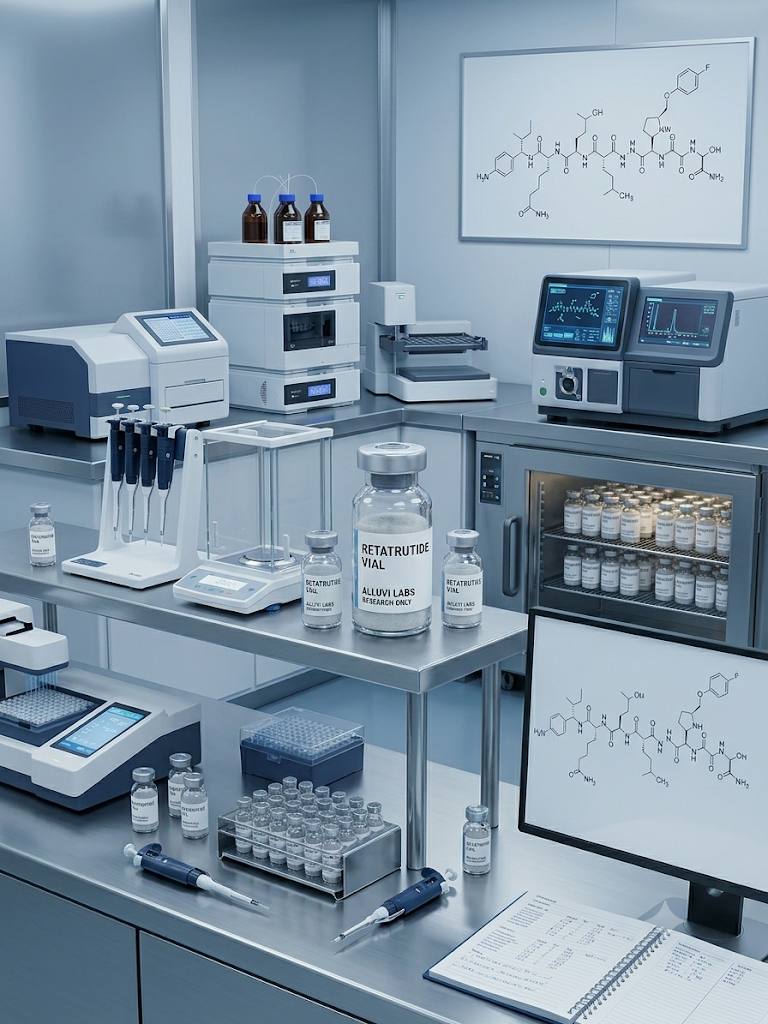
Peptide Reconstitution Guide: The Definitive Laboratory Guide for Reconstituting Lyophilized Vials
In preclinical evaluation and in vitro assay models, the accuracy of your baseline data depends entirely on the mechanical execution of your fluid preparation stage. Lyophilized peptides arrive as highly unstable, vacuum-sealed cakes engineered to maintain long-term structural integrity. However, turning that dry powder back into a uniform liquid solution—a process known scientifically as reconstitution—demands strict adherence to strict sterile techniques and precise volumetric mathematics.
An error during this sensitive phase can cause rapid hydrolytic cleavage, immediate peptide degradation, or ambient bacterial contamination, entirely invalidating your laboratory results. This definitive guide details the exact biochemical steps, calculations, and handling mechanisms required to execute perfect peptide reconstitution.
💧 Step 1: Selecting the Correct Reconstitution Solvent
You must never use standard tap water, mineral water, or unbuffered saline to reconstitute active research peptides. The two primary laboratory-grade solvents used to transition solid cakes into stable liquid vectors are:
- Bacteriostatic Water (0.9% Benzyl Alcohol): This is the gold standard multi-use solvent for the vast majority of research models. The inclusion of 0.9\% benzyl alcohol (C_7H_8O) serves as an elite preservative agent, effectively arresting the replication and growth of potential microscopic contaminants. This properties extend the stable shelf-life of your mixed solution across long-term testing matrices.
- Sterile Water for Injection (Plain Solvent): This fluid is completely devoid of preservative additives. It is chosen exclusively for hyper-sensitive cell cultures or localized tissue models where the presence of benzyl alcohol might trigger cellular toxicity or alter raw baseline metabolic readouts. Note: Once introduced to a vial, a plain sterile water solution must be used immediately and cannot be safely stored for repeated multi-dose assays.
Laboratory Asset Sourcing: Ensure perfect solution stability by sourcing your sterile solvents directly. View our high-purity Bacteriostatic Water 10ml Multi-Use Vials here
🧮 Step 2: Mastering the Reconstitution Mathematics
To determine the final concentration of your liquid active agent, you must map the total mass weight of the peptide against the precise volume of your added solvent. The fundamental equation governing this layout is:

To assist your lab technicians during workflow setup, utilize this quick-reference volumetric reference matrix:
Volumetric Reconstitution Concentration Matrix
| Total Vial Peptide Mass | Volume of Bac Water Added | Resulting Concentration Per 0.1ml (10 IU) |
|---|---|---|
| 10mg (e.g., MT1 / Tirzepatide) | 1.0 ml | 1.0 mg |
| 10mg (e.g., MT1 / Tirzepatide) | 2.0 ml | 0.5 mg |
| 20mg (e.g., Dihexa) | 2.0 ml | 1.0 mg |
| 40mg (e.g., MOTS-c) | 2.0 ml | 2.0 mg |
| 50mg (e.g., GHK-Cu / Epitalon) | 2.5 ml | 2.0 mg |
🧪 Advanced Protocol Development: Running high-volume longevity or metabolic assays? Equip your team with our premium Epitalon 50mg Vials and Tirzepatide 10mg Vials to guarantee consistent baseline purities.
🔬 Step 3: Step-by-Step Sterile Handling Protocol
Phase A: Pre-Preparation & Environmental Cleansing
- Sterilize the Workspace: Wipe down all analytical equipment, hoods, and counter surfaces using a fresh application of 70\% isopropyl alcohol.
- Thermal Equilibrium: Allow your lyophilized peptide vial to naturally warm up to standard room temperature (20^\circ\text{C} to 22^\circ\text{C}) before opening. Introducing cold glass to ambient air can trigger condensation within the vial, causing premature hydrolytic breakdown.
- Septum Decontamination: Pop off the plastic protective caps from both your active peptide vial and your bacteriostatic water vial. Thoroughly swab the exposed rubber stoppers using an alcohol prep pad, wiping in a single direction to clear any lingering micro-particles.
Phase B: Fluid Extraction & Equalization
- Equalize Internal Pressures: Draw air into your laboratory syringe equal to the exact volume of solvent you intend to extract. Insert the needle through the bacteriostatic water stopper, inject the ambient air into the vial to equalize the pressure, invert the container, and slowly draw down the liquid fluid.
- Manage the Vacuum Flow: High-quality research peptide vials are sealed under a strict internal vacuum layer. When inserting your fluid-filled syringe into the peptide vial, do not let the vacuum forcefully violently rip the liquid out of your barrel. Hold the plunger firmly to retain total manual speed control.
Phase C: Low-Stress Flow Dynamics
- Angle Against the Glass: Direct your needle tip away from the center of the vial. Slowly slide the liquid down the interior glass wall of the vial. Forcing a high-velocity stream of solvent directly into the center of a delicate lyophilized cake can shear fragile peptide bonds, destroying your active compounds before the assay even begins.
❌ Incorrect Method
[ Needle Vertical ]
| | | || |
| || |
======||======
| ↓ ↓ |
| [ CAKE ] |
| (Force Shear)|
==============
Direct Impact Jetting: Jetting the bacteriostatic solvent directly onto the lyophilized cake under heavy vacuum speeds causes extreme mechanical kinetic stress. This shears structural peptide rings and degrades active amino sequences instantly.
✅ Correct Method
[ Needle Angled ]
| | | // |
| // |
======//======
| / |
| / |
| v [CAKE] |
==============
Wall-Guided Diffusion: Restraining the syringe plunger and pointing the needle tip directly against the glass wall lets the solvent ease down the side. This allows for smooth capillary absorption without degrading molecular bonds.
🌀 Step 4: The Dissolution and Aggressive Motion Warning
Once the bacteriostatic water is successfully resting inside the vial, the solid compound must dissolve cleanly.
⚠️ Critical Laboratory Rule: Never Shake the Vial
Shaking or violently agitating a reconstituted peptide solution induces intense mechanical kinetic energy. This energy triggers rapid air-pocket foaming and alters the delicate secondary and tertiary structural folds of your peptide amino acid chains.
Instead, place the vial flat between your palms or on a level laboratory surface and gently roll it in smooth circular patterns for 30 to 60 seconds. If tiny particles or a thick blue cake structure (common in chelated variants like GHK-Cu) persist, transfer the vial to a dark refrigerator and allow it to rest undisturbed for 10 to 15 minutes. The compound will transition naturally into a completely clear, pristine liquid state.
❄️ Step 5: Post-Reconstitution Storage Parameters
Once converted to a liquid matrix, peptides become significantly more vulnerable to thermal degradation and light sensitivity.
- Temperature Restrictions: Store your mixed vials inside a dedicated laboratory refrigeration unit maintained strictly between 2°C and 8°C. Never freeze a peptide after it has been combined with liquid solvents, as ice crystal formations will physically tear the molecular structures apart.
- UV Exposure Barriers: Keep the vials shielded from direct sunlight or heavy overhead ultraviolet rays by returning them to their protective boxes or dark containment trays.
Summary Checklist for Reconstitution Workflow
- [ ] Allow all lyophilized materials to reach ambient room temperature before handling.
- [ ] Disinfect both vial stoppers using fresh 70\% isopropyl alcohol wipes.
- [ ] Calculate your exact target fluid volume using the mass-to-volume ratio equation.
- [ ] Angle the fluid syringe to slide the solvent smoothly down the interior glass wall.
- [ ] Gently roll the vial between your palms; never shake, vibrate, or agitate.
- [ ] Return the active liquid solution to dark storage between 2°C and 8°C.