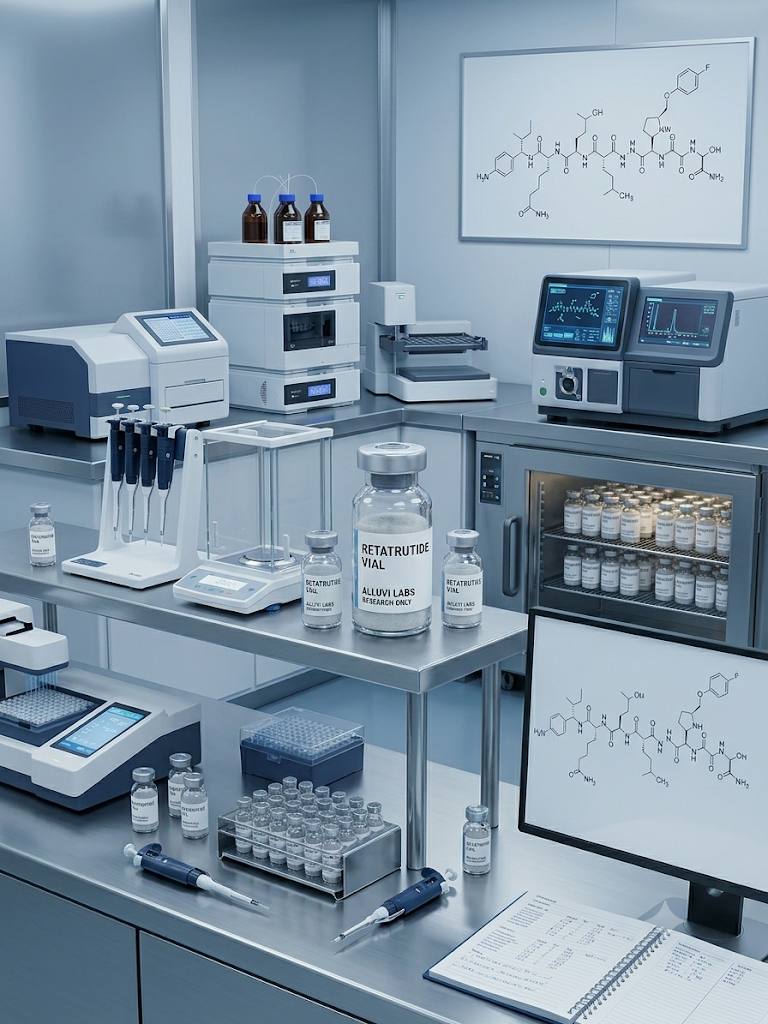
The Ultimate Guide to Peptide Stability and Laboratory Handling Protocols
In preclinical evaluation, maintaining an uncompromised molecular state is paramount to achieving accurate, reproducible experimental results. Lyophilized peptides are inherently delicate biochemical structures. Exposure to suboptimal environmental conditions or incorrect mixing techniques can trigger rapid hydrolysis, side-chain alterations, or complete sequence denaturation.
For research facilities managing high-purity assays, understanding the precise mechanisms governing peptide stability is critical to preserving compound integrity across long-term monitoring timelines. This guide details the essential biochemical rules, storage requirements, and safe operational parameters required for modern laboratory peptide handling.

What Controls Peptide Stability in Laboratory Conditions?
At a molecular level, peptide stability laboratory conditions are directly dictated by how well the compound is shielded from external energy sources and reactive molecules. When structural chains like BPC-157, TB-500, or GHK-Cu transition out of synthesis, their peptide bonds must be deliberately protected from three major degradation vectors:
- Thermal Degradation and Kinetic Energy
Room temperature environments induce constant kinetic motion at the atomic scale. Over time, ambient heat provides enough structural energy to disrupt weak hydrogen bonds and accelerate the degradation of fragile amino acid sequences.
- Hydrolytic Cleavage (Moisture Exposure)
The primary enemy of chemical shelf-life is moisture. When a peptide powder is exposed to ambient humidity or premature liquid solvents, water molecules interact with the peptide backbone. This triggers a chemical reaction known as hydrolysis, effectively clipping the amino acid chain and rendering the sample biologically inert. - Photo-Oxidation and UV Light Radiation
Ultraviolet (UV) radiation acts as a severe chemical catalyst. Exposure to direct light can mutate specific aromatic amino acid residues (such as tyrosine or tryptophan), leading to irreversible photo-oxidation and altering the baseline parameters of your cell culture studies.
Reconstitution Best Practices for High-Yield Assays
To ensure strict baseline parameters during an assay, researchers must transition a lyophilized cake into a liquid suspension using standardized, ultra-sterile techniques.
Step-by-Step Liquid Reconstitution Workflow:
- Thermal Stabilization: Remove the sealed peptide vial from deep freeze storage and allow it to sit at ambient room temperature for 15 to 20 minutes. This critical step prevents localized moisture condensation inside the vial when opened.
- Surface Sterilization: Clean the rubber septum of both the peptide vial and the sterile solvent vial using a fresh 70\% isopropyl alcohol wipe. Allow them to completely air-dry.
- Low-Pressure Solvent Introduction: Using a sterile laboratory syringe, draw the required volume of Bacteriostatic Water (0.9\% \text{ benzyl alcohol}) or physiological saline. Angle the needle directly against the glass interior wall of the vial. Slowly inject the solvent, letting the fluid cascade gently down the glass side rather than dropping directly onto the lyophilized cake.
- Equalizing Internal Pressure: Before withdrawing the syringe needle, lift it slightly above the fluid line but below the rubber stopper. Let the internal vacuum equalize naturally so your fluid volume measurements remain precise.
The Dangers of Mechanical Agitation
Shaking, dropping, or vigorously vibrating a liquid peptide solution causes immediate mechanical stress. This physical force shears the fragile secondary and tertiary structures of the peptide chains, causing irreversible aggregation. Always swirl the vial gently in a slow, circular counter-clockwise pattern to encourage complete dissolution.
Technical Peptide Stability Reference Matrix
To optimize your internal facility protocols and maintain flawless baseline control, utilize the technical reference standards outline below:
Integrating structural peptide stability testing timelines using analytical HPLC software guarantees that your active testing solutions have not suffered from hidden ambient degradation prior to introducing them into your cellular models.
Evaluating Distinct Preclinical Vectors: Tissue Repair vs. Metabolic Agonists
Modern peptide science requires investigators to keep a distinct barrier between completely separate research fields. A common point of confusion arises when comparing localized cytoprotective agents to global metabolic pathways.
For example, when tracking glycemic control, energy homeostasis, or weight management pathways in animal models, researchers look exclusively at dual incretin mimetics like “mounjaro” or “tirzepatide”. Tirzepatide functions explicitly as a 39-amino-acid synthetic dual agonist, binding simultaneously to both GIP and GLP-1 receptors to trigger downstream cyclic adenosine monophosphate (cAMP) generation inside pancreatic islets and hypothalamic appetite control centers.
Conversely, if the primary goal of the study is soft-tissue reconstruction, fibroblast migration velocity, or microvascular capillary alignment, metabolic agonists are bypassed. Instead, investigators deploy tissue-repair compounds such as a targeted [bpc-157 tb-500 blend]. This pairing activates distinct cellular pathways—specifically upregulating Vascular Endothelial Growth Factor (VEGF) and driving F-actin polymerization.
Understanding these differences prevents cross-contamination of experimental theories and ensures that your chosen chemical structure precisely matches your laboratory goals.
Why Purchasing Chemically Validated Batches is Paramount
Executing meticulous laboratory peptide handling is only half the battle. If your initial compound arrives with underlying chemical structural variations, your final datasets will be inherently skewed. High-purity, vacuum-sealed lyophilized blocks represent the pinnacle of data security. Sourcing materials that have been strictly verified via High-Performance Liquid Chromatography (HPLC) and Mass Spectrometry ensures your project maintains perfect, predictable molecular baselines from day one.
🔬 Laboratory Research & Development Disclaimer
All chemical compounds, structural sequences, and peptide matrices referenced across this educational guide are synthesized exclusively for in vitro and in vivo laboratory research, analysis, and development applications. They are strictly not intended, authorized, or approved for human consumption, direct clinical injection, diagnostic implementation, or cosmetic placement. All handling procedures must be conducted by qualified research professionals within licensed laboratory environments.