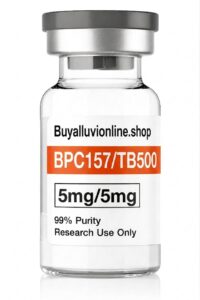
BPC157/TB500 BLEND Peptide Vial 5mg/5mg
£44.99
HPLC Tested – UKAS & ISO 9001 – >99% Purity
-20°C Cold-Chain Storage
SIZE: 10MG
Same-Day Dispatch (Before 4pm)
BPC-157 / TB-500 Blend Peptide Vial (5mg / 5mg)
What is the BPC-157 & TB-500 Blend?
The BPC-157 TB-500 blend is an advanced, dual-action formulation that combines two of the most heavily researched regenerative peptides into a single, high-purity vial. Premixed at a precise 5mg / 5mg ratio (yielding 10mg of total active peptide compound per vial), this configuration is specifically engineered for laboratory settings requiring simultaneous dual-pathway analysis without the logistical hassle of separate reconstitution steps.
This optimized BPC-157 TB-500 mix includes:
- BPC-157 (5mg): The cytoprotective gastric pentadecapeptide that acts locally to upregulate fibroblast migration and structural collagen synthesis.
- TB-500 (5mg): The highly mobile, active 17–23 amino acid segment of Thymosin Beta-4, known for its rapid systemic actin-binding and cellular motility properties.
By combining both molecules into a singular lyophilized matrix, researchers can observe immediate biological cross-talk and synchronized cellular kinetics within a controlled testing environment.
The Science of Synergy: Dual-Action Cellular Cascades
Utilizing a combined tissue repair peptide vial allows investigators to evaluate how these two compounds mutually amplify one another’s cellular repair mechanisms. Rather than operating in isolation, the blend coordinates a multi-tiered approach to tissue remodeling:
1. Synchronized Angiogenesis & Blood Vessel Repair
Tissues like tendons, ligaments, and cartilage inherently suffer from poor blood flow, which significantly slows natural recovery. The BPC-157 component triggers early-stage angiogenesis by upregulating Vascular Endothelial Growth Factor (VEGF). Simultaneously, the TB-500 component promotes endothelial cell differentiation. Together, they rapidly build and stabilize new microvascular capillary networks, maximizing nutrient perfusion at the injury site.
2. Enhanced Motility Matched with Structural Synthesis
A primary obstacle in cellular repair is moving healthy cells to a damaged zone. The TB-500 in this blend upregulates actin polymerization (converting G-actin to F-actin), giving cells the structural flexibility and motility required to migrate quickly across tissue planes. Once those cells arrive at the designated site, BPC-157 immediately drives fibroblast proliferation and initiates the rapid layout of organized Type I collagen.
3. Balanced Anti-Fibrotic Environments
Unregulated inflammation typically results in the accumulation of random, brittle scar tissue, which permanently decreases joint flexibility. Preclinical data shows that a combined BPC 157 TB 500 5mg 5mg profile works to downregulate aggressive pro-inflammatory cytokines while suppressing overactive transforming growth factor-beta (TGF-\beta) pathways. This ensures that newly formed tissue retains its native elasticity and tensile strength.
Primary Areas of Focus in Blend Research
Because of its convenient, pre-calculated ratio, this peptide blend for research is heavily utilized across diverse experimental models:
- Complex Soft-Tissue Trauma: Evaluating multi-structural injuries where muscle tears, tendon shears, and ligament sprains happen concurrently.
- Accelerated Dermal Wound Repair: Investigating superficial wound contraction speeds, tissue re-epithelialization, and cellular migration behaviors.
- Joint and Cartilage Homeostasis: Assessing how dual-peptide kinetics influence chondrocyte viability and prevent post-traumatic arthritic degradation.
Technical and Chemical Specifications
Every single BPC-157 TB-500 blend vial is precisely formulated and verified via high-performance liquid chromatography (HPLC) and mass spectrometry to ensure exact molar accuracy and zero cross-contamination.
| Specification Parameter | BPC-157 Component | TB-500 Component |
|---|---|---|
| Mass Per Vial | 5mg | 5mg |
| Chemical Structure | 15 Amino Acids (Pentadecapeptide) | 7 Amino Acids (Acetylated Fragment) |
| Molecular Formula | C62H98N16O22 | C38H68N10O14 |
| Molecular Mass | 1419.53 g/mol | 889.01 g/mol |
| CAS Number | 137525-51-0 | 885340-08-9 |
| Purity Profile | ≥ 98.5% | ≥ 98.0% |
| Physical Appearance | Sterile, Lyophilized Uniform White Cake | Sterile, Lyophilized Uniform White Cake |
- Storage Requirements: Keep un-reconstituted, lyophilized vials desiccated at -20°C for long-term molecular stability. Reconstituted fluid solutions must be refrigerated at 2–8°C.
Why Buy Our BPC-157 / TB-500 Blend Vial?
When looking to buy BPC-157 TB-500 blend vial products online, standard manufacturing cannot always guarantee uniform distribution inside a single container. Our state-of-the-art co-lyophilization process ensures that the 5mg of BPC-157 and 5mg of TB-500 are molecularly integrated into a perfectly uniform cake. This eliminates any risk of uneven dosing or variable chemical concentration upon reconstitution, providing completely reliable baseline metrics for your research.
Laboratory Research Disclaimer
This product blend is synthesized strictly for in vitro and in vivo laboratory research and development applications. It is strictly not intended, cleared, or approved for human consumption, clinical diagnostic protocols, cosmetic placement, or veterinary therapeutic applications. All purchasing entities must be qualified, licensed research professionals.
Frequently Asked Questions (FAQ)
- How should this 5mg/5mg blend vial be reconstituted?
For standard laboratory evaluation, the lyophilized cake should be carefully reconstituted using sterile Bacteriostatic Water (0.9\% \text{ benzyl alcohol}) or sterile Physiological Saline (0.9\% \text{ NaCl}). Introduce the liquid slowly along the side of the glass wall to prevent shearing the delicate peptide structures. - What are the benefits of a pre-made blend vs. buying separate vials?
A pre-made blend drastically reduces laboratory preparation time, lowers the cost of consumables (such as separate mixing vials and needles), and completely removes the human margin of error associated with calculating exact volumetric ratios between two separate liquids. - Does co-lyophilization cause the peptides to break down faster?
No. In their dry, lyophilized (freeze-dried) state under a protective vacuum seal, both chemical structures remain entirely stable and completely inert. They do not interact or degrade one another as long as they are kept at the recommended storage temperatures (stored desiccated at -20°C).
For comparative standalone baseline tracking, explore our ultra-pure Epitalon 50mg Vials or review our comprehensive scientific Peptide Reconstitution Guide to optimize laboratory solution stability parameters.
Related Research Articles
BPC-157 vs TB-500: Research Differences and Mechanisms
Tissue Repair Peptides in Scientific Research
Peptide Storage and Stability Guide
Peptide Reconstitution for Laboratory Research
What Are Research Peptides? Complete Overview
Advanced Analysis: Exploring the 40mg Cumulative Research Model
In advanced, long-term preclinical assays, high-yield configurations—such as a combined bpc 157 40mg cumulative study design—are frequently utilized to evaluate deep-tissue saturation points. When establishing robust baseline metrics across extensive, multi-week cellular observation periods, maintaining a unified batch profile is critical to eliminating chemical anomalies.
Why Molar Consistency Matters in High-Volume Research
Deploying a consistent sequence across a complete bpc 157 40mg research protocol ensures that variables like fibroblast migration velocity and VEGF-driven endothelial proliferation remain stable. Utilizing our molecularly uniform 5mg/5mg blend vials or bulk multi-packs allows researchers to scale their cellular exposures precisely without encountering the batch-to-batch variations common in lower-volume, non-standardized chemical syntheses.
Technical FAQ Addendum
- How does a bpc 157 40mg protocol translate to multi-vial reconstitution?
In large-scale cellular assays requiring a total yield of 40mg, researchers distribute volume calculations across identical high-purity vials (such as eight separate 5mg units or four 10mg units). Each vial should be independently reconstituted with sterile Bacteriostatic Water to avoid premature structural degradation or peptide clipping in liquid suspension. - Can the BPC-157/TB-500 blend be utilized in high-volume cumulative studies? Yes. Co-lyophilized blends are highly favored in high-throughput cellular repair models because they provide a fixed, precise 1:1 molecular ratio across the entire scope of the project, ensuring flawless reproducibility across high-capacity data sets.