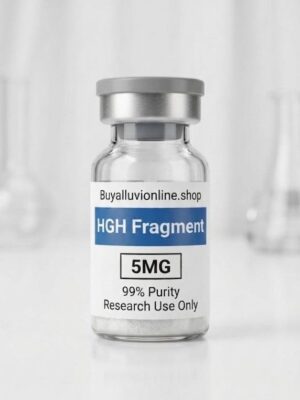
AOD9604 (Advanced Lipolytic Fragment)
Price range: £57.99 through £104.99
✓ Quality Checked
✓ Third-Party Verified
✓ Third-Party Verified
AOD9604 (Advanced Obesity Drug 9604) is a premium synthetic peptide fragment representing the C-terminal region of human growth hormone (hGH 177-191) with a stabilizing tyrosine modification. It is highly specialized for researching isolated lipolytic signaling pathways without stimulating insulin-like growth factor-1 (IGF-1) expression or altering systemic glucose sensitivity. For laboratory and in vitro research use only. Not for human consumption. Not a medicine.
🧮
Peptide
Calculator
AOD9604 | Isolated Lipolytic Somatotropin Fragment
AOD9604 is a modified 16-amino acid synthetic peptide derived specifically from the lipolytic C-terminal domain of the human growth hormone molecule (specifically encompassing residues 177–191). The architectural framework of this peptide features an additional terminal tyrosine residue, which stabilizes the tertiary peptide formation against immediate enzymatic degradation without altering its core operational affinity.
Unlike the native, full-length growth hormone cascade, AOD9604 is explicitly engineered to isolate adipose tissue breakdown pathways from wider somatotrophic actions. Preclinical analysis demonstrates that this fragment selectively drives fat reduction mechanisms without binding to standard growth hormone receptors. Consequently, it avoids the systemic side effects typically seen with full-length hGH, such as systemic insulin resistance, hyperinsulinemia, fluid retention, or the proliferation of insulin-like growth factor-1 (IGF-1).
Experimental Research Context & Mechanisms
During laboratory in vitro assays and preclinical cellular mapping, AOD9604 serves as a crucial control agent for evaluating:
- Beta-3 Adrenergic Agonism Paths: Evaluating the non-adrenergic mechanisms through which the peptide stimulates lipolysis within harvested adipocytes, leading to the metabolic breakdown of stored triglycerides into free fatty acids.
- Anti-Adipogenic Signaling: Investigating the molecular pathways that suppress lipogenesis—specifically tracking the reduction of fat-free nutrient conversion into new fat cell matrices.
- Cartilage Matrix Extracellular Regeneration: Emerging cellular modeling looks into AOD9604’s synergistic interactions within articular cartilage, studying its impact on proteoglycan synthesis and joint tissue repair assays.
Peptide Profile & Specifications
| Molecular Formula: | C78H123N23O23S2 |
| Molecular Mass: | 1815.08 Da |
| Sequence Architecture: | Tyr-Leu-Arg-Ile-Val-Gln-Cys-Arg-Ser-Val-Glu-Gly-Ser-Cys-Gly-Phe |
| Purity Threshold: | ≥99.0% Checked via HPLC & Mass Spectrometry Analysis |
| Physical State: | Lyophilized White Solid Powder (Vacuum Sealed Cake) |
| Available Quantities: | 5mg (5,000 mcg) & 10mg (10,000 mcg) Vials |
Laboratory Storage & Handling Protocols
To maintain the accurate disulfide bridge alignments vital for the structural stability of AOD9604 during experimental research, enforce the following handling measures:
- Lyophilized Storage: Store unreconstituted vials strictly in a laboratory freezer at -20°C for long-term storage. Keep environments dark, dry, and thoroughly isolated from moisture. Avoid frequent temperature adjustments.
- Reconstitution Calibration: Allow the vacuum-sealed vial to balance gradually to ambient laboratory room temperature before introducing any liquid solvent. This prevents thermal shock from disrupting the structural stability of the fragment.
- Post-Solvent Management: Store reconstituted solutions strictly between 2°C and 6°C. Never shake the liquid vigorously; use a soft, circular swirling movement to gently dissolve the lyophilized powder. It is highly recommended to complete data capture models within 10 to 14 days of fluid introduction.
⚠️ Preclinical Integrity Notice
All laboratory assets documented within this registry are distributed exclusively for verified laboratory research, analytical control trials, and foundational in vitro testing models. These chemical compounds are strictly not approved for human therapeutic, clinical, veterinary, or diagnostic administration.
| Dosage | 5mg, 10mg |
|---|---|
| Class | Modified Growth Hormone (GH) C-Terminal Fragment |
| Purity | ≥99.0% Purity (HPLC & Mass Spectrometry Verified) |
| Form | Lyophilized Freeze-Dried Solid Powder |
| Primary Vector | Lipolysis Stimulation & Anti-Adipogenic Signaling Assay |