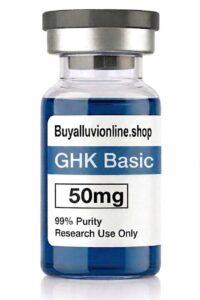
Peptide Research Labs GHK Basic 50mg delivers a high-purity, unchelated parent tripeptide sequence formulated explicitly as a foundational baseline control for cellular repair and matrix modeling assays. Vacuum-sealed to ensure a completely mineral-free structural state, this 50mg standalone vial allows investigators to isolate and evaluate the independent signaling mechanics of the raw Glycyl-L-Histidyl-L-Lysine framework during comparative in vitro analysis.
Purity Standard: >98% composition verified via analytical HPLC.
Primary Research Vector: Optimized for control-line comparative assays, gene expression tracking, and isolated fibroblast response tracking.
Our standalone chemical matrices are strictly authorized for laboratory research and development applications. Not for human consumption or direct clinical implementation.
Complete your comparative cellular repair and signaling assays with Peptide Research Labs’ ultra-pure GHK Basic 50mg lyophilized vial. GHK Basic (Glycyl-L-Histidyl-L-Lysine) is the unchelated, pure parent tripeptide molecule isolated from human plasma. In preclinical models and tissue culture tracks, this standalone carrier peptide is heavily documented for its independent affinity for cell-surface receptors, functioning as a vital baseline control to measure the exact biological acceleration differences when copper ions are absent versus when they are chemically complexed.
Our standalone 50mg units provide an exceptional baseline configuration for extended in vitro skin matrix tracking, comparative biochemical modeling, and gene expression control profiling.
To maintain total experimental integrity and protect against faulty background data, every single batch of our GHK Basic inventory undergoes rigorous solid-phase peptide synthesis followed by exhaustive analytical validation:
Verified Chemical Purity: Exceeds 98% composition confirmed directly via analytical High-Performance Liquid Chromatography (HPLC) profiles.
Controlled Non-Chelated Baseline: Synthesized strictly without the introduction of copper(II) trace minerals, allowing researchers to evaluate the isolated peptide framework without metallic ionic interference.
Visual Baseline Check: Lyophilized into a crisp, pristine white uniform cake—offering an immediate visual contrast to the deep royal blue coloration of our chelated GHK-Cu lines.
Atmospheric Protection: Vacuum-sealed under an inert gas layer inside standard glass laboratory vials to prevent premature atmospheric oxidation or hydrolytic cleavage.
Investigated Preclinical Action Channels
In peer-reviewed cellular tracking and matrix regeneration models, the unchelated GHK sequence demonstrates independent, foundational biological pathways:
Extracellular Matrix Baseline Mapping: Studies utilize GHK Basic to map the default activation parameters of dermal fibroblasts, observing how the raw amino acid sequence interacts with collagen type I and elastin synthesis tracks.
Gene Expression Modulation: Research indicates that the GHK architecture itself can modulate the expression of structural genes, acting as a molecular coordinator even prior to mineral loading.
Comparative Mineral Chelation Assays: Investigators frequently implement this raw matrix to observe how effectively the standalone structure sequesters surrounding ambient minerals within an active cellular assay fluid.
Product Specification Reference Table
Specification Parameter
Laboratory Standard Value
CAS Number
49557-75-7 (Base Free)
Molecular Formula
C14H24N6O4
Taste / Odor Profile
Odorless / Non-flavored Raw (Analytical Powder)
Total Active Content
50mg Lyophilized Powder
Solubility Profile
Freely Soluble in Sterile Water / Aqueous Buffer Systems
🔬 Preclinical Research Notice
This unchelated chemical matrix is synthesized strictly for in vitro laboratory analysis, cell culture tracking, and comparative baseline research models. It is absolutely not intended, authorized, or safe for human therapeutic injection, topical cosmetic implementation, dietary intake, or consumer use. All handling must be managed exclusively by qualified laboratory technicians.