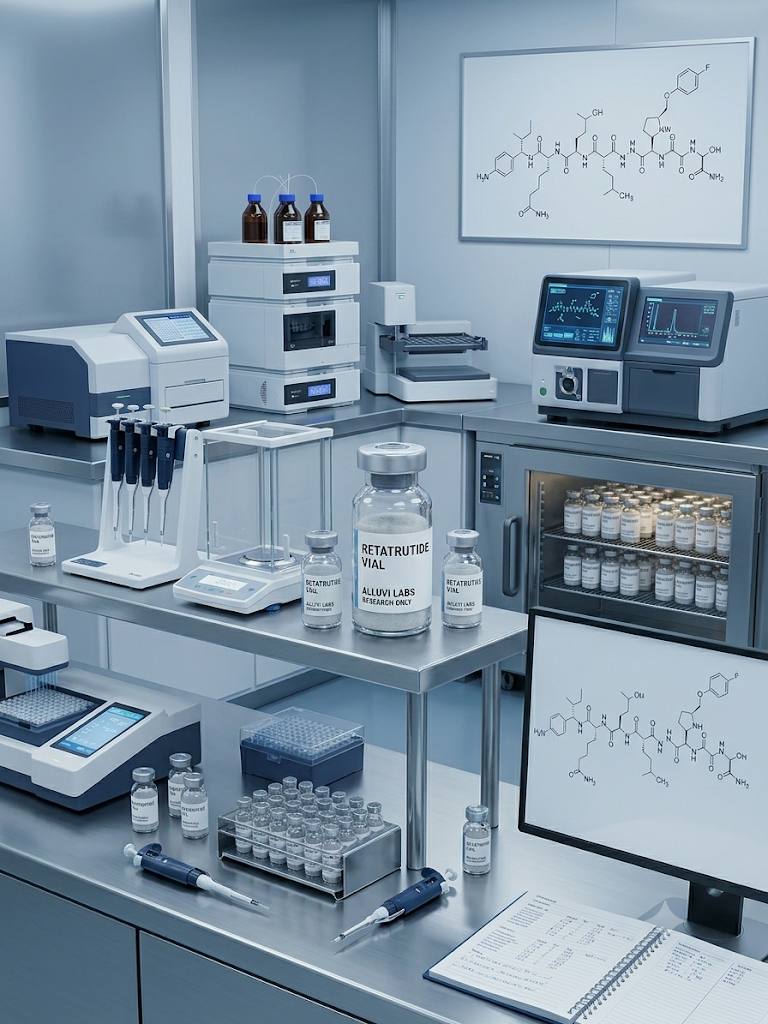
GLP-1 5mg (Glucagon-Like Peptide-1)
£59.99
✓ Quality Checked
✓ Third-Party Verified
✓ Third-Party Verified
Glucagon-Like Peptide-1 (GLP-1) 5mg is a premium, synthetically produced endogenous incretin peptide hormone. It serves as a foundational biochemical tool for replicating insulinotrophic signaling cascades and investigating glucose-dependent metabolic homeostasis in vitro. For laboratory and in vitro research use only. Not for human consumption. Not a medicine.
🧮
Peptide
Calculator
GLP-1 Peptide | Core Incretin Hormone Reagent
Glucagon-Like Peptide-1 (GLP-1) is an endogenous peptide hormone primarily synthesized by the intestinal L-cells. It functions as a core component of the incretin system, modulating systemic nutrient disposition and glycemic balance. This 5mg variant provides an analytical-grade reagent engineered specifically to isolate native receptor affinity profiles, offering an unadulterated baseline for metabolic comparison against longer-acting synthetic variations (such as Semaglutide or Tirzepatide).
In native physiological landscapes, GLP-1 is rapidly inactivated by the ubiquitous enzyme dipeptidyl peptidase-4 (DPP-4), leading to a brief half-life of mere minutes. In laboratory evaluation models, this high clearance rate makes native GLP-1 an excellent candidate for mapping rapid cellular responses, localized pancreatic islet interaction dynamics, and real-time enzyme degradation velocities within controlled bioassays.
Experimental Research Context & Mechanisms
During preclinical investigation, GLP-1 is deployed to investigate a broad spectrum of physiological feedback mechanisms, focused predominantly on:
- Glucose-Dependent Insulin Secretion: Binding to GLP-1 receptors located on pancreatic beta-cells to trigger adenylate cyclase, raising intracellular cAMP levels and evaluating insulin exocytosis solely in high-glucose conditions.
- Gastric Transit and Deceleration Models: Mapping the slowing of upper gastrointestinal motility and its corresponding downstream effects on nutrient absorption rates.
- Central Nervous System Satiety Pathways: Studying receptor interaction curves within the hindbrain and hypothalamus that control hunger signaling and energetic expenditure baselines.
- Glucagon Counter-Regulation: Analyzing the direct pathway mechanics through which pancreatic alpha-cells reduce glucagon output during nutrient assimilation curves.
Peptide Profile & Specifications
| Molecular Formula: | C149H226N40O45 |
| Molecular Mass: | 3297.68 Da |
| Sequence Architecture: | His-Ala-Glu-Gly-Thr-Phe-Thr-Ser-Asp-Val-Ser-Ser-Tyr-Leu-Glu-Gly-Gln-Ala-Ala-Lys-Glu-Phe-Ile-Ala-Trp-Leu-Val-Lys-Gly-Arg-Gly |
| Purity Threshold: | ≥99.0% (HPLC & Mass Spectrometry Analytical Verification) |
| Physical Presentation: | Freeze-dried uniform lyophilized solid cake under negative pressure |
| Total Mass Content: | 5mg (5,000 mcg) per vial |
Laboratory Storage & Handling Protocols
To safeguard the structural integrity of the delicate amino acid sequences and preserve receptor binding fidelity, enforce the following physical handling guidelines:
- Lyophilized Preservation: Store un-opened vials inside a stable laboratory freezer at -20°C for optimal lifespan. Keep the environment desiccated and thoroughly shielded from light exposure. Avoid constant temperature shifts.
- Solvent Introduction: Before adding a liquid bacteriostatic solvent, allow the vacuum-sealed vial to balance completely with ambient room temperature. This step prevents thermal stress from cracking or altering the fragile peptide crystalline configuration.
- Reconstituted Solution Protocol: Keep liquid solutions stored strictly between 2°C and 6°C. Do not agitate or aggressively shake the reconstituted solution; mix using a gentle swirling pattern instead. For maximum experimental accuracy, utilize the solution within 7 to 10 days post-reconstitution.
⚠️ Preclinical Integrity Notice
All laboratory assets documented within this registry are distributed exclusively for verified laboratory research, analytical control trials, and foundational in vitro testing models. These chemical compounds are strictly not approved for human therapeutic, clinical, veterinary, or diagnostic administration.
| Class | Incretin Hormone / GLP-1 Receptor Agonist |
|---|---|
| Purity | ≥99.0% Purity (HPLC Verified) |
| Form | Lyophilized Solid Powder |
| Primary Vector | Glucose-Dependent Insulin Secretion & Satiety Signaling Assay |